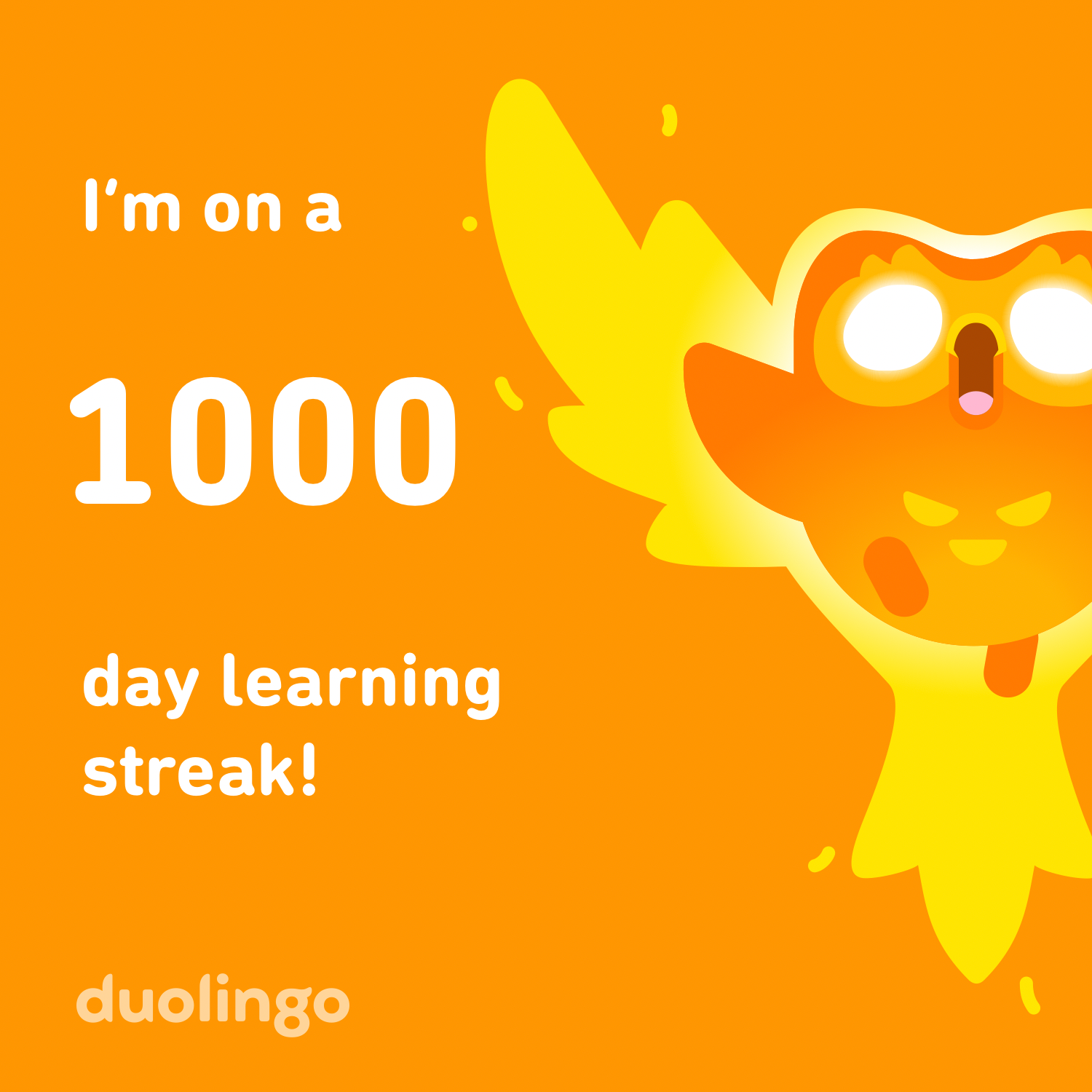
One Thousand Days of Duolingo
Saturday, January 24, 2026
Today I reached a 1,000-day Duolingo streak. I pay for it, and I have used streak freezes, but the last one I used was in March 2024. I’ve only used eight in total.
When I started learning Spanish one thousand days ago, I had no real intention of taking it this far. I started it a month or two before I had a planned vacation in Mexico and a conference in Costa Rica. Since that time, I’ve practiced my Spanish in four or five Kazakh cities, London, Brussels, Frankfurt, Istanbul, Costa Rica, and Mexico. I’ve practiced it through great life accomplishments, through getting furloughed and laid off, and through some pretty deep depression. The last thousand days have been a roller coaster and a period of immense change for me, and, strangely enough, Duolingo has been one of the few things truly consistent in my life throughout that time.
So after all this time, you might be wondering how my Spanish is. It’s…. Fine? Pretty good, even. My “Spanish Score” in Duolingo is 95, which Duolingo is happy to tell me is equivalent to a “high B1” level of CEFR, the Common European Framework of Reference for Languages, probably the closest thing we have to a standardized way of measuring language proficiency. According to Duolingo, this means I “can confidently handle most daily situations and explain my ideas.” After a bunch of Spanish-language chats with my partner Ánge, occasional conversations with her family and friends, and several brave attempts to speak only Spanish at some of my favorite PG County taquerias, I think that’s probably true. I also, for the most part, have no problem watching television and movies in Spanish, although I do still prefer to turn on the (Spanish-language) subtitles. The way that I actually feel is that I’m ready for a true immersion opportunity. I think I’m at a level where if you dropped me in a Spanish-speaking environment for a month or two, I’d be chatting and socializing freely in Spanish in short order.
Throughout the last one thousand days, there have been times when I did the bare minimum to keep my streak alive. When I’m doing the bare minimum and only one lesson per day, I’ve felt my Spanish growth come to a halt. When I’ve done 3 or 4 lessons a day, about 30 minutes worth, this is when I can feel myself progress. One rather fuzzy goal I’ve had most days, to reach this amount, is to complete the “Daily Quests” that Duolingo gives me every day. When I’ve gone through periods where I’ve really felt like I was progressing quickly, I was usually also pairing the Duolingo with plenty of listening, such as a Spanish-language Netflix show or a podcast. I’ve also experimented with online Spanish tutors, which have been helpful but, frankly, quite expensive for the immediate benefit. By the time I was really ready to benefit from tutors, I had already lost my job at NED, and money became much more of an issue.
Which takes me to the next big philosophical change I’ve adopted in my Spanish learning journey, which is “comprehensible input”, the linguist Stephen Krashen’s theory that the best way to learn a language is to have lots of input that you understand in the language you’re learning, perhaps through context, coupled with a much smaller amount of input that is truly new to you. I’m not a linguist or a language educator, but I can say that this philosophical approach has led me to adopt a much more relaxed attitude towards learning Spanish, which has been helpful. When I learned Russian, I learned it through a traditional classroom model, which involved a lot of memorization and grammar tables. Learning Russian felt like a daily exercise in banging my head against the wall and hoping I learned something. I got there, but learning it was very painful. Learning Spanish (admittedly much easier than Russian for a native English speaker) has felt much more natural.
I mention comprehensible input because I want to say that I think Duolingo has been an incredibly useful tool, but in itself, not enough. I think the many podcasts and shows I’ve listened to and watched have also played a key role in my journey.
Duolingo has been an incredibly useful tool, and I intend to keep using it as long as it continues to serve me. That said, if I were starting today, I’d probably explore other alternatives to see if it’s still the best one for me. Duolingo’s gotten a lot of heat lately for its plans to replace contract workers with AI. That sucks. That said, I also think LLMs are incredibly well-suited for language practice. As a paying Duolingo user, I have access to its AI features, and I can say that conversing with Duolingo’s AI bots has felt like a very low-pressure way to get started speaking, which has greatly aided me in my preparedness and courage to speak in Spanish when I have opportunities to speak with real people. One of the biggest criticisms I have always heard about Duolingo has been that it doesn’t help you actually speak, but these AI features truly do.
If I were starting today, I probably would still look for an app that included an AI bot as part of its model.
Up next in my journey is to try to have more real-life conversations in Spanish.
When I started learning, I didn’t expect it to get this far, but learning Spanish, as with Russian before it, feels like a superpower and has added a whole new dimension to my life and my understanding of the world.